


TLDR: The best evidence we have says roughly 60 per cent of budget on brand and 40 per cent on activation, and that the split matters less than whether the two work as one job. AI has raised the stakes: more of the buying journey now happens before anyone reaches your website, in places your analytics cannot see. Below is how I think about the split with the boards I work with, and what I would do this quarter with a limited budget.
On this page:
- Why do brand and performance drift apart?
- What does the evidence say about the split?
- How has AI changed the answer?
- So where should your budget go?
- What I would do this quarter
- FAQ
Why do brand and performance drift apart?
Walk into most scaling businesses and you will find brand people and performance people, and a board that leans heavily towards the performance side. I see it constantly. Performance marketing produces a spreadsheet: spend this, get that many leads, close that many sales. Finance people love something attributable, and I understand why. I sit in those conversations every month.
Brand produces no such spreadsheet, or at least not a weekly one. So when budgets tighten, brand is the line that gets cut, and the drift begins. Two teams, two sets of numbers, one of which looks accountable and one of which looks like faith.
The problem is over a century old. The line usually credited to John Wanamaker, “half the money I spend on advertising is wasted; the trouble is I don’t know which half”, still describes most marketing meetings I attend. The difference now is that the unmeasurable half is doing more of the work than ever.
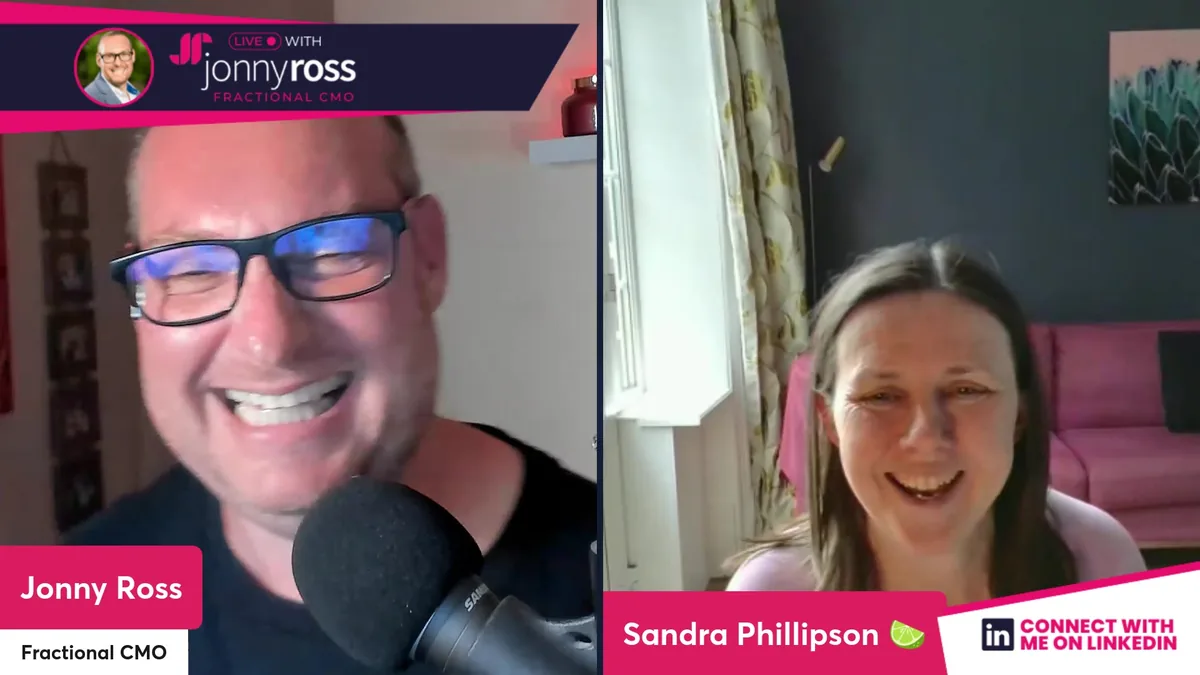
On this week’s podcast I put the drift question to brand strategist Sandra Phillipson, who spent most of a 25-year career in brand and customer strategy, much of it inside one of the UK’s biggest banks. Her answer was that the fix is structural. More on that below.

What does the evidence say about the split?
The most quoted answer comes from Les Binet and Peter Field’s analysis of nearly 1,000 campaigns in the IPA databank, published as The Long and the Short of It. They found that campaigns weighted around 60 per cent brand building and 40 per cent sales activation produced the largest total profit gain, because brand effects compound over years while activation effects decay in weeks. Their later work nudged the optimum to roughly 62:38. If you want one number to anchor on, that is the best-evidenced one available. (IPA: the key works of Binet and Field)
Sandra reached for Mark Ritson’s framing on the episode, and it is the version I find lands best in a boardroom: your brand warms up the roughly 90 per cent of your future customers who are not ready to buy yet, and your performance marketing converts the ones who are. Run them in isolation and you get neither the warmth nor the conversion working properly. Run them together and you get a multiplier.
Notice what neither of those says. Neither says brand is a logo project, and neither says performance is a waste. The evidence is an argument for balance held over time, which is precisely what a board under quarterly pressure finds hardest to do.
Sandra’s line about North Face lands the point:
“They don’t sell jackets. They sell adventure.”
Sandra Phillipson, episode 139
That is what the 60 per cent buys you: positioning that creates preference before the buying moment, which is also what lets a business charge more. Sandra’s view from inside a big bank was blunt on this point. Big businesses do not invest in brand because they have spare money. They invest because the return justifies it.
How has AI changed the answer?
Here is where the conversation got most useful for anyone running a scaling business in 2026.
Sandra’s working numbers, and I should say these are her rules of thumb from practice rather than published studies: buyers now face around 255 daily distractions and give you about 2.6 seconds of attention; Daniel Priestley’s old rule of seven hours, eleven touchpoints and four platforms has multiplied to something like 24 touchpoints; and around 70 per cent of the buying journey now happens before anyone clicks on your website. Treat the specific figures as directional. The direction, though, matches exactly what I see across client analytics: website traffic softening, paid media costs rising, and buyers arriving later in their journey with their minds half made up.
Where did the rest of the journey go? AI assistants, AI Overviews, review sites, Reddit threads, forums. Places your attribution dashboard has no line for. Which means the attributable share of your marketing is shrinking, and a budget allocated purely on what can be measured will systematically starve the part doing the early work.
Sandra put a number on the payoff too, again as her working view: a buyer who arrives after seeing you recommended in an AI overview converts around three times higher than one who arrives cold. Whether it is three times or two, the mechanism is sound. A recommendation is a trust transfer, and trust is what brand builds.
So AI has not settled the brand versus performance argument, but it has quietly moved the weight towards brand, because being known, trusted and consistently described is now what determines whether the machines put you on the shortlist at all. I wrote about the mechanics of that shift in From clicks to citations: why mentions are the real SEO metric.
So where should your budget go?
The honest answer, and Sandra refused to give a formula on air when I pushed her, is that it depends on the state of your demand. But “it depends” is not useful on its own, so here is the decision logic I use with boards:
If you have demand you are failing to convert, fix performance first. Broken landing pages, slow follow-up and untracked conversions waste brand investment before it starts. Marketing spend upstream of a broken constraint amplifies the failure.
If your performance marketing is efficient but plateauing, with costs per lead creeping up quarter after quarter, that is usually the signal you have exhausted the in-market buyers who already know you. More spend on the same channels buys the same people at higher prices. That plateau is the strongest practical argument for shifting weight towards brand.
If you are somewhere in the middle, which most scaling businesses are, hold something close to the 60:40 shape and judge it over years rather than quarters. Brand spend judged on a 90-day dashboard will always look like the thing to cut. That is precisely how the drift starts.
And whatever the split, fix the ownership problem. Sandra’s structural answer on the episode was joint accountability, making brand awareness, engagement, experience and customer satisfaction shared numbers alongside sales, so success is, as she put it, “not just purely about number of widgets and sales”. In practice that means no longer measuring the brand team on awareness alone and the performance team on leads alone. In my experience the businesses that get this right stop having the budget argument entirely, because there is no longer a “them” to lose it to.
What I would do this quarter
Four moves, in order, all doable inside a quarter:
- Get your conversion tracking honest before touching the budget. Most SME analytics undercount commercial outcomes badly, which makes performance look worse and brand look unaffordable. You cannot rebalance what you cannot see.
- Baseline your brand’s footprint. Search your category the way a buyer would, in Google, in reviews, in the forums your market reads, and note where you are absent or described inconsistently. Half a morning, no budget.
- Pick one consistency fix. Sandra’s point about consistency beat everything else on the episode, and her observation was that a drip of steady, coherent activity gets better results than bursts. One message, showing up the same way everywhere, for a quarter. (I set out where content itself is heading in The future of content: what 2026 is really asking of marketers.)
- Put one shared number in front of the board. Even something as simple as share of branded search alongside cost per lead changes the conversation from either/or to both.
FAQ
Is the 60:40 rule right for a smaller business?
Treat it as a starting shape rather than a law. Binet and Field’s data skews towards larger advertisers, and their later work showed the optimum varies by category and context. The principle that transfers at any size is that brand compounds and activation decays, so a business spending nothing on brand is borrowing from its own future.
Should a new business start with brand or performance?
Performance-weighted at first, because you need cash flow and proof of demand. But get the positioning work done early even if the media spend comes later. Positioning is a decision, and decisions are cheap. Sandra’s framing on the episode was that brand is upfront work done properly once, which everything else then fits into.
How do you actually measure brand?
Imperfectly, but usefully. Share of branded search, direct traffic, review volume and sentiment, win rates against the same competitors, and increasingly your visibility in AI answers. None is perfect alone. Together they trend, and trends are enough to govern a budget.
Does AI search make performance marketing pointless?
No. Demand that already exists still needs converting, and performance does that job well. The risk is a budget built only from what the dashboard can attribute, when the attributable share of the journey keeps shrinking.
Where does your own business sit on all of this? We built a free scorecard that measures both sides, your brand and your AI visibility, in a couple of minutes. There is no pitch at the end; you get an honest picture of where you are strong and where the gaps sit: jonnyross.com/magic-multiplier.
I explored all of this with Sandra Phillipson on episode 139 of the podcast. Watch the full conversation:
How this was researched: this piece draws on my conversation with Sandra Phillipson (Crozest) on episode 139 of the Jonny Ross Fractional CMO podcast, the IPA-published effectiveness work of Les Binet and Peter Field, and patterns from the scaling SME boards I work with as a fractional CMO. Sandra’s statistics are her working numbers from practice, shared on air, rather than published research.